
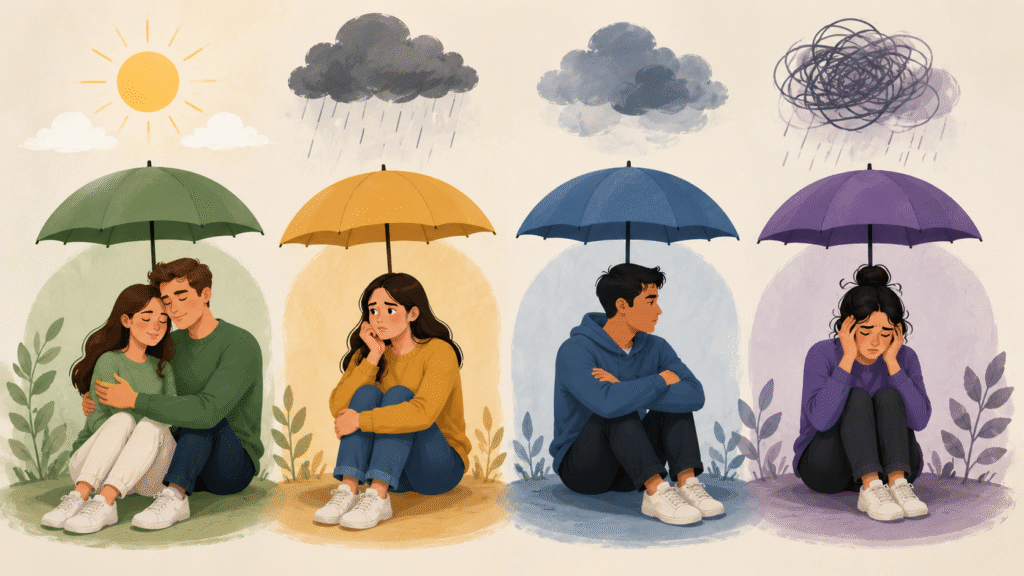
You have a friend who panics the moment a date doesn’t text back within an hour. They send three messages, then a sad emoji, then a ‘sorry if I did something wrong.’
You know someone else who seems perfectly calm when relationships end. Too calm, almost. They say ‘it’s fine’ and move on like nothing happened. You wonder if they ever really cared.
Then there’s the person who keeps choosing partners who are clearly unavailable. Married. Emotionally distant. Living in another city. You watch them get hurt the same way every time and you think ‘why don’t they just pick someone different?’
These aren’t just personality quirks. They are patterns. And they have a name.
Attachment styles.
The concept comes from research by psychologists John Bowlby and Mary Ainsworth in the mid-20th century. They studied how infants reacted to separation from their caregivers. What they found was that children developed consistent strategies for getting their needs met—strategies that often carried into adulthood.
Decades of research since then have confirmed something simple and important: the way you learned to love as a child often becomes the way you love as an adult. Not because you’re broken. Because your nervous system learned a pattern that kept you safe back then. And it’s still running that pattern now.
Let’s break down the four main attachment styles. No psychology degree required.
The simple version
Think of attachment style as your default setting for closeness. It answers three questions without you having to think about them:
🪞 How safe do I feel when someone gets close?
🪞 How worried am I that they will leave?
🪞 How do I act when I’m upset with someone I love?
Depending on your early experiences, your brain landed on one of four answers.
Style 1: Secure attachment
The short version: ‘I’m okay. You’re okay. We can figure this out.’
About 50-60 percent of people fall into this category, depending on the study.
A securely attached person doesn’t panic when a partner needs space. They don’t assume the worst when a text goes unanswered for a few hours. They can say ‘I’m upset’ without it turning into a crisis. They can hear ‘I need some time alone’ without hearing rejection.
This doesn’t mean they never feel jealous, anxious, or sad. They do. But those feelings don’t run the show. They can regulate themselves. They can ask for comfort without falling apart. They can give comfort without resentment.
What this looks like in real life:
🪞 They say ‘I’m annoyed about what happened earlier’ in a normal tone of voice.
🪞 They say ‘I need to go to bed’ and then go to bed without a negotiation.
🪞 They say ‘I miss you’ without it being a test.
🪞 When a partner is upset, they listen more than they defend.
Where it comes from:
Usually, consistent caregiving in childhood. Not perfect caregiving. Just good enough. The parent noticed when the child was distressed and responded reasonably well, most of the time. The child learned that needs get met and that the world is mostly safe.
The good news: Even if you didn’t grow up with this, you can move toward it. Adult relationships can rewire attachment patterns. It takes time and the right partner (or therapist). But it happens.
Style 2: Anxious attachment (also called preoccupied)
The short version: ‘I need you to prove you’re not leaving. Constantly.’
About 20 percent of people fall into this category.
An anxiously attached person craves closeness but never quite trusts it. They are hyper-aware of small changes in a partner’s tone, pace of texting, or body language. A slightly shorter message than usual can trigger hours of rumination.
They often describe themselves as ‘too much’ or ‘needy.’ They fear abandonment so deeply that they sometimes behave in ways that push people away—which then confirms their fear that everyone leaves.
What this looks like in real life:
🪞 They text three times in a row when the first one goes unanswered.
🪞 They say ‘are you mad at me?’ multiple times a week.
🪞 They re-read old messages to look for evidence that something has changed.
🪞 They have a hard time sleeping when there’s unresolved tension with someone.
🪞 They often feel like they care more than the other person does.
A typical internal monologue:
‘They seem distant today. Did I do something? They said everything is fine, but it didn’t sound fine. I should ask again. But if I ask again, they’ll think I’m clingy. So I won’t ask. But now I can’t focus on anything else.’
Where it comes from:
Inconsistent caregiving. Sometimes the parent was warm and available. Sometimes they were distracted or rejecting. The child never knew which version would show up. So they learned to stay vigilant. To monitor. To try harder. To perform.
As an adult, that vigilance becomes anxiety. And the ‘trying harder’ becomes protest behavior—texting, calling, crying, arguing—anything to get a reaction that proves you still exist to them.
Style 3: Avoidant attachment (also called dismissive)
The short version: ‘I don’t need anyone. And neither should you.’
About 20-25 percent of people fall into this category.
An avoidantly attached person values independence above almost everything else. They have learned—usually from painful experience—that depending on others is dangerous. So they simply stopped doing it.
They often describe their childhood as ‘fine’ but can’t recall many specific memories. They describe ex-partners as ‘too emotional’ or ‘needy.’ They are comfortable with distance and uncomfortable with too much closeness.
This doesn’t mean they don’t want connection. They do. Everyone does. But their nervous system reads closeness as a threat. So they withdraw. And they have excellent reasons—reasons that made perfect sense in their original family.
What this looks like in real life:
🪞 They say ‘I don’t need anyone’ and mostly mean it.
🪞 They go silent during arguments. Not because they’re punishing you. Because they genuinely don’t know what to do with strong emotions.
🪞 They rarely ask for help. Even when they clearly need it.
🪞 They minimize problems. ‘It’s fine. It’s not a big deal. Let’s just move on.’
🪞 They keep ex-partners at a clean distance. No drama. But also no real grief.
A typical internal monologue:
‘They’re upset again. I don’t know what they want from me. I didn’t do anything wrong. I think I’ll just go for a walk. This is why being alone is easier.’
Where it comes from:
Consistently rejecting or dismissive caregiving. The child learned early that showing distress led to being ignored, criticized, or turned away. So they stopped showing distress. They became self-sufficient. They told themselves ‘I don’t need them’ because needing them hurt too much.
As an adult, that self-sufficiency becomes a wall. They don’t leave relationships dramatically. They just never fully arrive in them.
Style 4: Fearful-avoidant attachment (also called disorganized)
The short version: ‘I want you close. But I’m terrified of you close.’
About 5-10 percent of people fall into this category. It’s the rarest and often the most painful.
A fearful-avoidant person experiences both anxious and avoidant patterns. They crave intimacy. Then they flee from it. They pursue. Then they push away. They are often described as ‘hot and cold’ or ‘difficult to read’—but from the inside, it’s not a game. It’s genuine chaos.
They want to be loved. But their early experiences taught them that the people who are supposed to love you are also the people who hurt you. So every close relationship becomes a war between ‘come here’ and ‘stay back.’
What this looks like in real life:
🪞 They idealize a new person for weeks, then suddenly ghost them.
🪞 They say ‘I think I’m falling for you’ and then pick a fight three days later.
🪞 They have a history of chaotic relationships. Lots of breakups and reconciliations.
🪞 They struggle to trust anyone, but also struggle to be alone.
🪞 They often describe themselves as ‘broken’ or ‘too complicated.’
A typical internal monologue:
‘I really like them. Like, really like them. That’s terrifying. What if they see the real me? What if they leave once they do? I should leave first. But I don’t want to leave. I’ll just text them. No, I won’t. I hate this. I hate that I can’t just be normal.’
Where it comes from:
Frightening caregiving. Often abuse, neglect, or a parent who was themselves deeply traumatized. The child’s attachment system was activated (they needed comfort) but the source of comfort was also the source of fear. There was no safe option.
So the child never developed a coherent strategy. As an adult, they swing between anxious pursuit and avoidant withdrawal. And they often end up in relationships with people who replicate the original chaos—because at least that feels familiar.

How these styles show up in arguments
A quick comparison.
| Situation | Secure | Anxious | Avoidant | Fearful-avoidant |
|---|---|---|---|---|
| Partner seems distant | ‘I’ll check in calmly.’ | ‘What did I do wrong?’ | ‘Good. I needed space.’ | ‘They’re leaving. I’ll leave first.’ |
| After a fight | Wants to repair. | Wants to reconnect immediately. | Wants to pretend it didn’t happen. | Wants connection and distance at the same time. |
| Being criticized | Listens, evaluates, responds. | Hears rejection. Collapses or fights. | Shuts down or deflects. | Alternates between collapse and shutdown. |
| Saying ‘I love you’ | Says it when they mean it. | Says it early and often. Tests response. | Rarely says it. Feels trapped by it. | Says it, then panics. |
Can your attachment style change?
Yes. This is important.
Attachment styles are not permanent diagnoses. They are learned patterns. And what is learned can be unlearned.
🪞 Secure people can become insecure after a traumatic relationship.
🪞 Anxious people can become more secure with a patient, consistent partner.
🪞 Avoidant people can learn to tolerate closeness with the right support.
🪞 Fearful-avoidant people can stabilize, though it often requires therapy.
The research on this is clear. Adult attachment styles are moderately stable but not fixed. A good relationship—romantic or therapeutic—can act as a ‘corrective emotional experience.’ Your nervous system learns a new pattern: closeness doesn’t have to hurt.
That said, change is slow. You’re not reprogramming an opinion. You’re reprogramming survival instincts. It takes time, repetition, and usually some professional help.
A note on compatibility
✗ Wrong question: ‘What attachment style is best?’
✓ Right question: ‘What attachment styles work well together?’
Secure + Secure: Usually smooth. Conflicts happen but repair happens too.
Secure + Anxious: Can work if the secure person is consistent and the anxious person is self-aware.
Secure + Avoidant: Can work if the avoidant person is willing to stretch toward closeness and the secure person doesn’t take withdrawal personally.
Anxious + Avoidant: This is the classic ‘push-pull’ relationship. Very common. Also very painful. The anxious person pursues. The avoidant person retreats. The anxious person tries harder. The avoidant person retreats further. Neither is wrong. They are just playing different games with different rules. This pairing works only if both do significant individual work.
Fearful-avoidant + anyone: Requires the most patience and the most professional support. Not impossible. But rarely smooth without outside help.
A final observation
You don’t need to memorize four categories. You just need to notice one thing: what happens inside you when someone gets close?
🪞 Do you relax? Or do you scan for danger?
🪞 Do you trust they’ll stay? Or do you wait for them to leave?
🪞 Do you reach out when you’re hurt? Or do you go silent?
Those answers aren’t judgments. They’re just data. Data about your past. Not your future.
Your attachment style is not your identity. It’s your default setting. And default settings can be adjusted. Slowly. With the right tools and the right people.
You don’t have to earn secure attachment by being perfect enough. You just have to find one or two relationships—therapist, partner, close friend—where you can practice being a little more open, a little more honest, and a little less defended than you were taught to be.
That’s it. That’s the work. Small repetitions over a long time.
And that’s something every attachment style can do.
Sources
- Bowlby, J. (1988). A Secure Base: Parent-Child Attachment and Healthy Human Development. Basic Books.
- Ainsworth, M. D. S., Blehar, M. C., Waters, E., & Wall, S. (1978). Patterns of Attachment: A Psychological Study of the Strange Situation. Lawrence Erlbaum.
- Levine, A., & Heller, R. (2010). Attached: The New Science of Adult Attachment and How It Can Help You Find—and Keep—Love. TarcherPerigee.
- Mikulincer, M., & Shaver, P. R. (2016). Attachment in Adulthood: Structure, Dynamics, and Change (2nd ed.). Guilford Press.
- Johnson, S. M. (2019). Attachment Theory in Practice: Emotionally Focused Therapy (EFT) with Individuals, Couples, and Families. Guilford Press.